Interior design in 2026 is increasingly preoccupied with verticality. As open-plan living spaces become taller and architectural ambitions rise, designers and homeowners are looking for features that honour the full height of a room rather than anchoring interest at eye level alone.
The vertical aquarium has emerged as one of the most compelling responses to this shift.
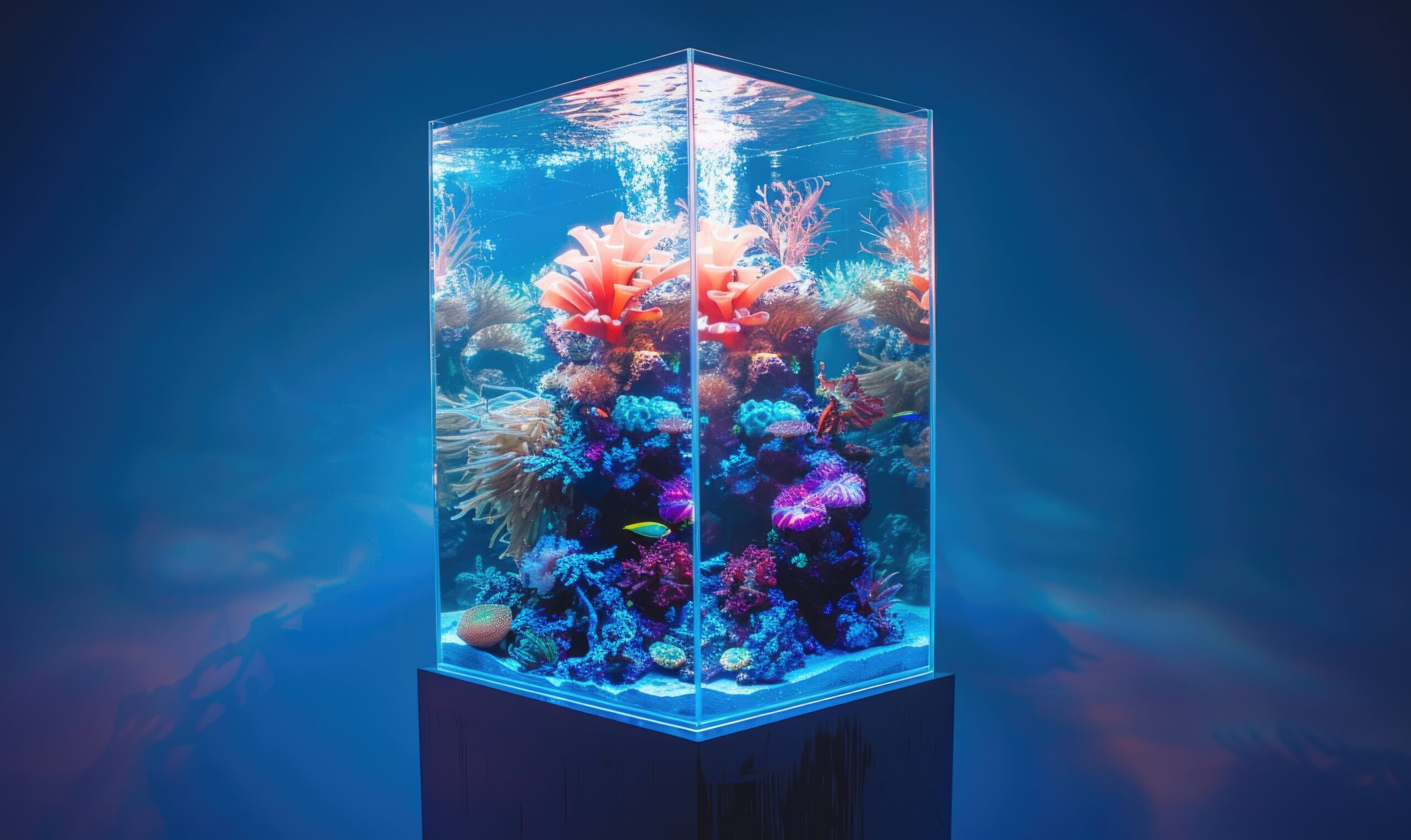
Whether expressed as a floor aquarium that extends from ground to ceiling, a cylindrical fish tank positioned as a freestanding column, or a tall, narrow format integrated into an architectural feature, the vertical aquarium brings movement, light, and a sense of living depth to spaces in a way that no horizontal format can fully replicate.
Why Choose a Vertical Aquarium?
The horizontal aquarium has been the default format for decades, shaped largely by the conventions of domestic furniture and the assumption that aquariums sit on surfaces.
However, as luxury residential and hospitality design has moved toward taller ceilings, double-height spaces, and an architectural language that draws the eye upward, the standard horizontal tank has come to feel increasingly static.
A vertical fish aquarium responds to the proportions of the modern luxury interior rather than working against them, using height to create impact and occupying the vertical plane in the same way that a large work of art or a floor lamp does, but with the additional quality of movement and living light.
There is also a spatial logic to the vertical format that is particularly useful in contemporary homes where floor space is considered carefully.
A tall, narrow aquarium or a cylindrical column tank occupies a relatively small footprint while delivering a visual presence that far exceeds its ground-level dimensions.
For rooms where wall space is limited or where the owner wants a significant focal point without committing a large portion of the floor area, the vertical format offers an elegant and efficient solution.
Key Vertical Aquarium Formats and Where They Work Best
The vertical aquarium category encompasses several distinct formats, each suited to a different spatial context and design intention:
- Floor aquarium (floor-to-ceiling) — the most architecturally ambitious format, spanning the full height of the room. This installation turns an entire wall or column into an immersive underwater environment and works best in entrance halls, double-height living spaces, and large reception rooms where the scale is appropriate.
- Cylinder aquarium — a freestanding column of water that can be positioned centrally within a room or against a structural element. The cylindrical aquarium invites viewing from every direction and functions as a sculptural centrepiece, making it ideal for dining rooms, open-plan areas, and hotel lobbies.
- Tall narrow panel — a vertically oriented rectangular tank designed to fit within a niche, between two architectural elements, or as a slim feature wall panel. This format is well suited to corridors, stairwells, and spaces where a slender vertical presence adds rhythm without overwhelming the surrounding interior.
Where to Place a Vertical Aquarium
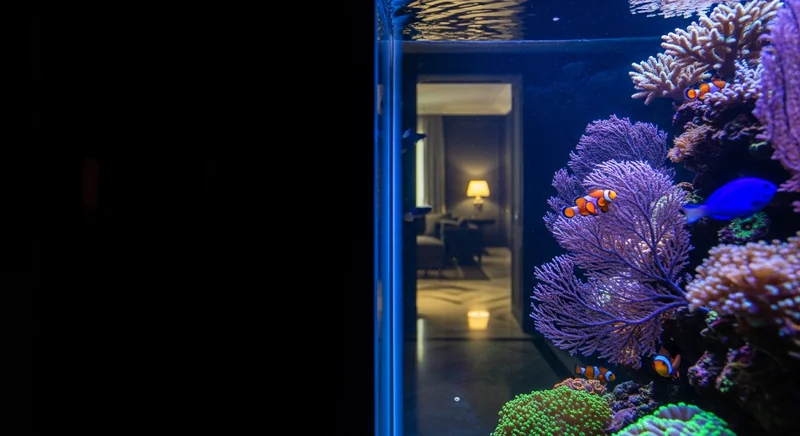
One of the most compelling qualities of a vertical aquarium is how it interacts with light. A tall column or floor-to-ceiling panel behaves like a luminous architectural element, casting soft, shifting reflections onto surrounding walls and ceilings as fish move through the water.
To maximise this effect, placement is important. Vertical aquariums work best where light can spread, near textured walls, natural materials such as stone or timber, or in circulation spaces where reflections remain visible from multiple angles. Avoid positioning the aquarium directly opposite strong sunlight, which can reduce clarity and increase algae growth.
Lighting inside the tank should be designed as part of the room’s overall lighting scheme. High-output LED systems are typically required for tall aquariums to ensure even illumination from top to bottom, preventing darker lower sections. In some installations, layered lighting or multiple light sources help maintain visual balance across the full height.
In spaces with high ceilings or large glazing, the interaction between natural daylight and the aquarium’s internal lighting changes throughout the day. This shifting quality is part of the appeal, allowing the aquarium to function not only as a focal point but also as a subtle ambient light source within the interior.
Installing a Vertical Aquarium
Installing a vertical aquarium requires planning that goes beyond standard horizontal tanks. Height increases structural loads, affects water circulation, and changes how maintenance access must be designed. Addressing these elements early ensures the installation is both visually integrated and technically reliable.
Structural Considerations
The primary structural factor is water pressure, which increases significantly with height. Taller aquariums require thicker glass or acrylic panels, reinforced seams, and in many cases a structural frame designed specifically for the tank’s dimensions. For floor-to-ceiling installations, laminated glass or high-grade acrylic is typically specified to safely manage the higher pressure at the base.
Related content: Acrylic vs Glass Aquarium
Floor load capacity is another critical consideration. A vertical aquarium concentrates substantial weight into a relatively small footprint. Even a slim column can weigh several hundred kilograms when filled, while floor-to-ceiling installations may exceed a tonne. Positioning the aquarium near load-bearing walls, structural beams, or ground-floor slabs is often recommended, particularly in residential settings.
Support structures should also account for vibration and stability. Tall tanks benefit from rigid cabinetry or metal framing that prevents flexing and distributes weight evenly. In some cases, anchoring the installation to a wall or ceiling structure improves long-term stability, especially for cylindrical or freestanding formats.
Technical Considerations
Water circulation behaves differently in tall aquariums, making vertical flow management essential. Without proper design, upper and lower zones can develop uneven temperature, oxygenation, and filtration. Tall installations typically use stronger return pumps, multiple outlets at different heights, or closed-loop systems to maintain consistent water movement throughout the column.
Filtration placement is equally important. Remote filtration systems located below the tank, in cabinetry, or in a dedicated service area are often preferred, allowing adequate capacity without compromising the clean vertical aesthetic. For very tall aquariums, overflow positioning and return flow must be carefully engineered to avoid dead zones.
Maintenance access should be planned from the outset. Floor-to-ceiling aquariums may require service hatches, removable panels, or overhead access, while tall freestanding tanks need sufficient clearance above the waterline for cleaning tools and feeding. Designing access early prevents disruptive modifications later.
Lighting also becomes more technical in vertical formats. Taller tanks benefit from layered lighting or high-output LED systems to ensure consistent illumination from top to bottom, preventing darker lower sections and maintaining visual balance.
Choosing fish for a Vertical Aquarium
The vertical format encourages a more deliberate approach to fish selection, as species can be chosen not only for colour but also for how they occupy different levels of the water column. A well-composed vertical aquarium distributes movement from base to surface, creating a layered and visually balanced display.
For the mid-water zone, schooling species are particularly effective. Angelfish, rainbowfish, and selected tetra species create continuous movement through the central portion of a tall tank. Their natural swimming behaviour and, in some cases, vertical body shape complement the proportions of the aquarium.
The lower section benefits from calmer species that add visual stability. Discus, gouramis, or peaceful cichlids introduce slower movement, while bottom-dwellers such as corydoras or small plecos animate the base without dominating the composition.
Near the upper levels, smaller active fish help complete the vertical layering. Hatchetfish, rasboras, or surface-oriented tetras bring subtle motion near the waterline and draw the eye upward, particularly when combined with carefully designed lighting.
A balanced vertical composition typically combines:
- one visually dominant mid-water species
- one slower, larger species for the lower zone
- a small active group for the upper levels
- optional bottom-dwelling fish for subtle movement at the base
This layered approach creates depth, rhythm, and visual progression from bottom to top, allowing the full height of the aquarium to function as a living design element rather than a single plane of movement.
Frequently Asked Questions
Are vertical aquariums harder to maintain than horizontal ones?
Maintenance requirements for vertical aquariums are broadly similar to those of horizontal installations of comparable volume. The main practical consideration is ensuring that access points for cleaning, water changes, and feeding are designed into the installation appropriately. For very tall tanks, maintenance platforms or dedicated service access may be required, and these should be planned during the design phase rather than addressed retrospectively.
What ceiling height is needed for a floor-to-ceiling aquarium?
There is no fixed minimum, but floor-to-ceiling aquariums tend to create the most impressive results in rooms with ceiling heights of at least 3 metres. In spaces with lower ceilings, a tall panel format, which does not necessarily extend to the full ceiling height, can deliver a similar sense of vertical presence without requiring the structural complexity of a true floor-to-ceiling installation.
Can a cylindrical aquarium be installed in an existing home?
Yes, cylindrical aquariums are among the more adaptable formats for existing homes because they are freestanding and do not require structural integration into walls or floors. The main considerations are floor load capacity, proximity to water supply and drainage for maintenance, and ensuring that the space around the tank allows for comfortable viewing and regular access.
Is a vertical aquarium suitable for a commercial space?
Vertical aquariums are excellent choices for commercial hospitality environments such as hotel lobbies, restaurant entrances, and private members’ clubs. Their visual impact is immediate and memorable, and the vertical format often integrates well with the tall ceilings and generous proportions typical of commercial spaces. Commercial installations typically benefit from a professional maintenance arrangement to ensure the display remains in optimal condition.
The vertical aquarium is not simply a trend
As spaces grow taller, more open, and more architecturally ambitious, the features within them need to match that ambition. A well-designed vertical aquarium brings height, movement, and living light to a room in a way that few other installations can achieve, and it does so with a refinement that makes it equally at home in a private residence or a distinguished commercial space.
For anyone considering this direction, a consultation is the natural first step toward understanding what is possible in a specific interior.