Keeping jellyfish in a fish tank at home has moved from a specialist curiosity to a genuinely achievable goal for aquarists who are prepared to understand what these animals actually need.
Jellyfish are not fish, and they do not thrive in the same environment! They are soft-bodied invertebrates that drift on ocean currents, with no brain, no bones, and no real ability to navigate around obstacles.
In a standard rectangular aquarium with corners, sharp filter intakes, and strong directional flow, jellyfish do not survive long.
This guide explains what a proper jellyfish home aquarium looks like, which species work best for home environments, how to care for them day to day, and which mistakes most commonly lead to problems.
Why a Standard Fish Tank Does Not Work for Jellyfish
The single most important thing to understand about keeping jellyfish in a fish tank is that the standard rectangular aquarium format is fundamentally unsuitable for them.
Jellyfish are pelagic animals, meaning they spend their lives suspended in open water. They have no means of avoiding obstacles, and even moderate water flow can push them into corners, filter intakes, or walls where their delicate tissue tears.
The solution developed by public aquariums and later adapted for home use is the kreisel tank.
The name comes from the German word for gyroscope. A kreisel is a cylindrical or toroidal tank designed to produce a gentle, circular water flow that keeps jellyfish suspended in the center of the water column without pushing them against any surface.
Filter inlets are screened or positioned so that suction cannot reach the jellyfish. The interior walls are smooth and curved, with no sharp corners.
For a jellyfish home aquarium to work, the tank design must follow these principles.
Which Species Work Best for Home Jellyfish Aquariums
Moon Jellyfish (Aurelia aurita)

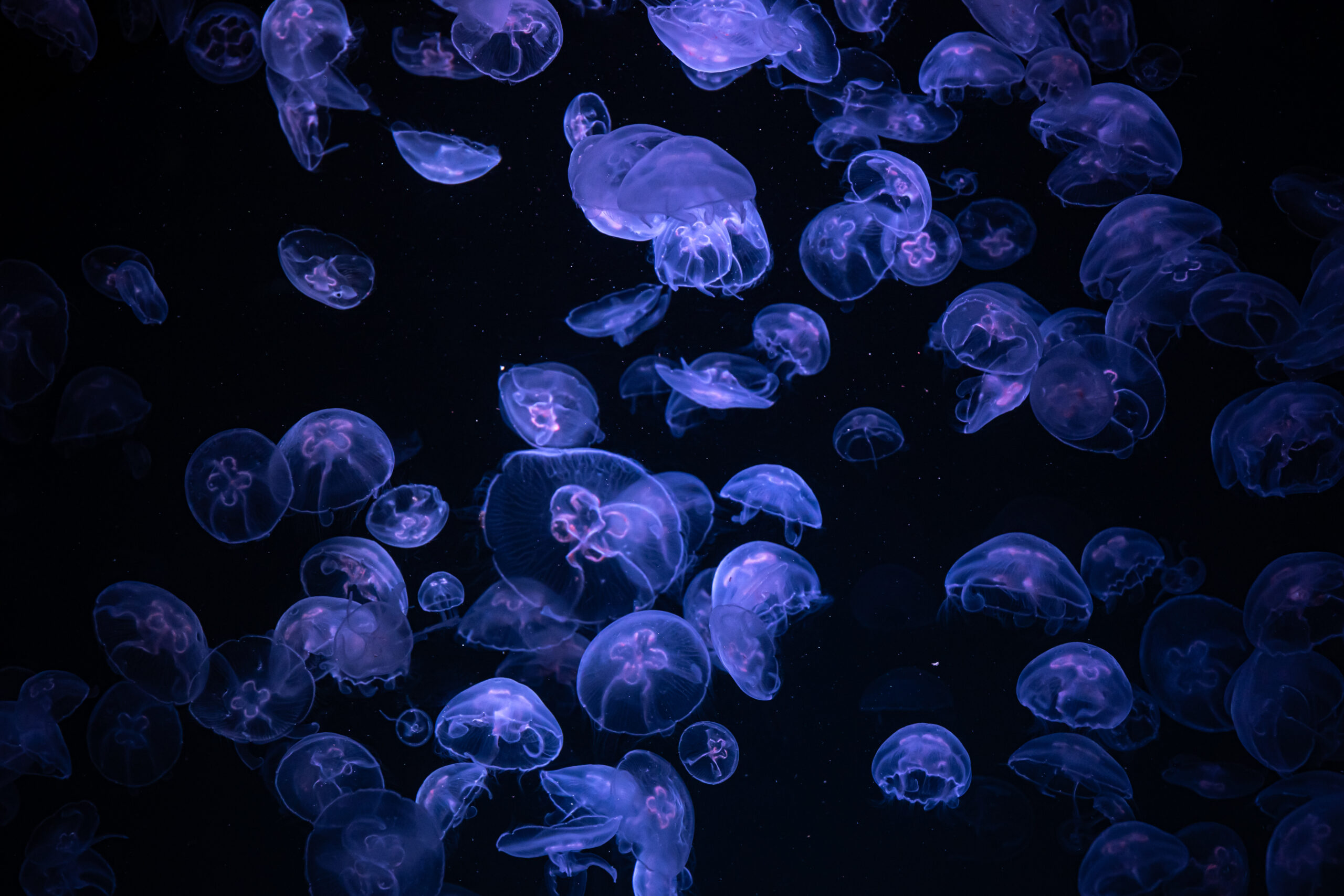
Moon jellyfish are the most widely kept species for home aquariums and the most forgiving for those new to jellyfish tanks. They grow to approximately 15 centimeters in captivity, prefer cooler water (18 to 25°C), and are available from specialist suppliers as captive-bred animals, which are considerably more resilient than wild-caught specimens. Their translucent bell with four distinctive ring markings responds well to colored LED lighting, making them one of the most visually striking options for a display jellyfish aquarium.
Upside-Down Jellyfish (Cassiopeia)

Cassiopeia species are unusual in that they spend most of their time resting upside-down on the substrate rather than drifting. This makes them significantly easier to keep than pelagic jellyfish, as the water flow requirements are less demanding. They prefer shallow, warm water and a sandy substrate. Their lace-like oral arms in shades of blue, green, and brown create a distinctive visual effect. For those interested in a jellyfish tank that is easier to manage, Cassiopeia is a well-regarded starting point.
Lagoon Jellyfish (Mastigias)

Lagoon jellyfish contain symbiotic algae in their tissue, which means they benefit from exposure to moderate light. They are intermediate in difficulty and produce a distinctive spotted appearance. They are more commonly available in specialist jellyfish suppliers than in general aquarium retailers.
Tank Setup and Equipment Requirements for a Jellyfish Tank
A jellyfish tank only works if the system is designed around flow, safety, and stability. Standard aquariums are not suitable.
A functional setup requires a kreisel or pseudokreisel tank, which uses a circular water flow to keep jellyfish suspended without contact with corners or filter intakes. The internal structure must be completely smooth, with no sharp edges or stagnant zones.
The filtration system should be biological only at tank level, paired with a sump or external filtration unit sized for full biological load. The tank must be fully cycled before any animals are added, as jellyfish are highly sensitive to ammonia and nitrite.
Water movement is the most critical technical factor. Flow must be:
- strong enough to keep jellyfish in suspension
- gentle enough to avoid damaging the bell
- adjustable, especially during feeding
All intake points must be fully screened or indirect, as even low suction can injure or kill jellyfish.
Lighting is secondary but still important. LED systems with adjustable intensity are typically used to maintain visibility without overheating the water.
For temperature-sensitive species (especially moon jellyfish), a chiller may be required to keep water within a stable range. Temperature stability is more important than hitting an exact value.
Feeding and Day-to-Day Care
Jellyfish feeding is simple in principle but requires consistency.
The main food source is live zooplankton, most commonly newly hatched brine shrimp (Artemia nauplii). These should be fed in small, controlled amounts to avoid fouling the water.
Typical routine:
- feed 1–2 times per day
- stop flow briefly during feeding if needed
- resume circulation after feeding is complete
- remove excess food when visible accumulation occurs
Water quality must be maintained through:
- regular small water changes (around 10–15% weekly)
- stable salinity and temperature
- consistent biological filtration performance
The most important handling rule is never expose jellyfish to air or nets. Transfers should always be done in water using a container or cup. Air bubbles trapped under the bell can cause serious damage.
Daily observation matters more than intervention. Changes in swimming rhythm, positioning, or feeding response are usually the first indicators of a problem.
Common Mistakes That Lead to Problems with Jellyfish in a Fish Tank
Most guides on jellyfish tanks cover the care requirements without being specific about the practical errors that cause the most problems. These are the patterns that practitioners encounter most often.
Using the wrong tank type
A standard rectangular aquarium is unsuitable. Corners trap jellyfish and create injury points. Only kreisel-style systems or proper circular flow tanks should be used.
Adding jellyfish before cycling is complete
The nitrogen cycle must be fully established before introduction. Ammonia and nitrite spikes are lethal even at low levels. This process typically takes 4–6 weeks.
Incorrect flow settings
Too much flow causes physical damage. Too little flow causes sinking and stagnation. Many problems come from failing to adjust flow between feeding and normal operation.
Mixing species or adding fish
Jellyfish must be kept in a species-only system. Different species can sting or damage each other, and fish will almost always injure jellyfish tentacles.
Poor feeding control
Overfeeding is more dangerous than underfeeding. Excess food quickly degrades water quality and leads to bacterial imbalance.
Air exposure during handling
Lifting jellyfish into air, even briefly, can cause irreversible damage. All transfers must remain fully submerged.
Underestimating system stability
Jellyfish tanks are not “decorative aquariums.” They are closed life-support systems. Stability in flow, temperature, and filtration matters more than any visual factor.
Frequently Asked Questions
How long do jellyfish live in a home aquarium?
Moon jellyfish typically live for approximately 12 months in captivity under good conditions, though some specimens have been maintained for longer. Lifespan depends significantly on water quality, feeding consistency, and the stability of the environment. Jellyfish go through distinct life stages from polyp to ephyra to medusa, and some species can regenerate from the polyp stage under appropriate conditions.
What size tank do jellyfish need?
For a small group of moon jellyfish, a tank of 20 to 40 liters in a kreisel format is workable as a starting point. Larger volumes produce more stable water conditions and support more animals. For a display jellyfish aquarium in a residential setting where visual impact is the priority, a larger custom kreisel of 100 liters or more delivers a significantly more impressive result.
Can jellyfish be kept with other invertebrates?
Generally no. Most invertebrates that might be considered for a jellyfish tank will either be damaged by the jellyfish’s stinging cells or will damage the jellyfish themselves. Jellyfish tanks are typically species-only setups for this reason.
Are jellyfish tanks difficult to maintain?
They require consistent, attentive care but are not necessarily more difficult than a well-maintained reef tank once the system is established. The main challenges are maintaining appropriate water flow, ensuring reliable food supply, and managing water quality carefully during the cycling period and first months of operation.
What is the best jellyfish for a home aquarium?
Moon jellyfish (Aurelia aurita) are the most widely recommended species for home aquariums. They are available as captive-bred animals, are forgiving of minor variations in water conditions compared to more sensitive species, and respond well to the lighting conditions that create the most visually striking display. Upside-down jellyfish (Cassiopeia) are a useful alternative for those who find the flow requirements of pelagic species challenging.
Thinking About a Jellyfish Display for Your Home?
Jellyfish in a fish tank, when the system is designed correctly, produce a visual effect that is entirely unlike any other aquarium format. The translucent, pulsing movement of jellyfish against a lit cylindrical tank creates something that reads as art as much as it does as a living exhibit.
For those interested in a custom jellyfish installation designed around a specific space, we work with clients to define the right format, species selection, and ongoing care approach for each project. Asking for consultation is the most direct way to understand what is possible within a given environment.